The Textile Museum
February 18 - July 30, 2000
|
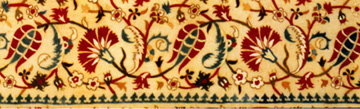
Detail - Cover Fragment,
Turkey, Istanbul, Early 18th Century
acquired
by George Hewitt Myers
Courtesy of The Textile
Museum
|
Our Ottoman theme takes center stage as
we highlight the current exhibition at The Textile Museum in
Washington, DC, featuring over fifty embroidered textiles spanning
the late 16th to early 20th centuries. As the Ottoman Empire
flourished so too did its decorative arts. The textiles produced
during the Ottoman reign provide a window onto the opulent culture
which produced them. By exploring Ottoman cultural traditions
we can better understand how social changes, environment and
economy influenced textile production and design style. Floral
imagery is ubiquitous in the embroidery of the Ottomans and pays
homage to their love of flowers. On view is a veritable garden
of stitched tulips, carnations, hyacinths, pomegranates and arched
floral branches which replicate the splendor of Ottoman gardens.
Like a long buried treasure now brought to light, many of these
embroideries have never before been displayed or published.
|
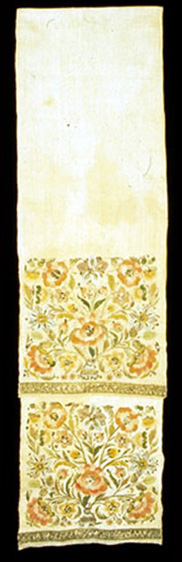
Uckur (Sash) - Turkey
Late
18th or Early 19th Cent.
Courtesy of The Textile
Museum
Gift of Mrs. Hoffman Philip
|
Textiles of all kinds played a pivotal
role, influencing many aspects of Ottoman ceremonial and day-to-day
life. At the top of the hierarchy were the needlework designs
of the Nakkashane, the royal design atelier. Draftsmen copied
these patterns for distribution to a populace anxious to emulate
palace styles. Eventually they found their way to the far reaches
of the vast Ottoman Empire, where the designs were employed not
only by textile artists but also by potters, painters and others.
As trade routes were firmly established with Western Europe in
the early 18th century, a blending of the exotic Ottoman designs
with the exuberant style of European Rococo took place culminating
in the unique aesthetic known as Turkish Rococo.
|
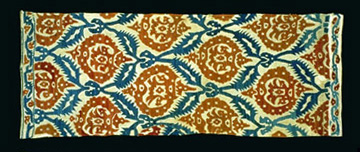
Cover Fragment, Turkey 18th
Century
Courtesy of The Textile Museum
Acquired
by George Hewitt Myers, 1934
|
The Nakkashane attracted the brightest
lights in the design world of the times, bringing a vast pool
of talent together at the Topkapi Palace in Istanbul. Here influences
from the numerous cultures which the Ottoman Empire encompassed
were blended resulting in a distinctive style. Decorative textiles
defined an individual's status both at court and in society at
large. They were made into garments, wrappings, ornaments, covers,
household furnishings, wall hangings, room dividers and daily
linens. Some were further enhanced with gilded threads, sequins,
gems and semi-precious stones. More extravagantly embellished
textiles were inextricably linked with ceremonial life and family
celebrations, such as weddings, births and circumcisions. Apparel,
accessories and footwear for these events projected an aura of
luxury, created as they were with luscious silks and sparkling
metallic threads.
|
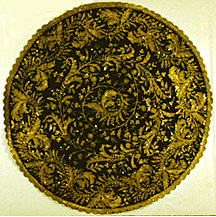
Tray Cover - Turkey, 19th
Century
Courtesy of The Textile Museum
Gift
of Mrs. Fred S. Gichner
|
The Imperial city of Istanbul was the seat
of power of the vast Ottoman Empire and also the center for trade.
The bazaars within this culturally diverse city were renowned
for textiles, embroidered by both men and women. The men labored
primarily in urban workshops producing large works from heavy
materials and integrating them with the more costly materials
of pearls, gold, precious and semi-precious stones. Since social
custom restricted women to their homes, they occupied themselves
with needlework in the haremliks (women's quarters). Embroidery
was considered a suitable pastime for women and training in the
needlearts formed an integral part of a young girl's upbringing.
Women were equally adept in stitchwork as their male counterparts,
were allowed to earn an income from their labors and to furnish
their own homes. Handmade textiles were furthermore an indication
of the wealth and status of a woman's family and reflected her
skill as a needleworker.
The interior of a typical Ottoman home
consisted of both haremlik/harem (women's quarters) and selamnik
(men's quarters). The main rooms of the haremlik were surrounded
on three sides by divans scattered with cushions. Pillows and
other textiles were colorfully embroidered with gold and silk
threads depicting floral motifs emulating a garden indoors. Floors
covered with mats and carpets were also littered with cushions
to provide seating. The largest embroidered textiles were covers
and wall hangings. Bedding consisted of mattresses, covers and
pillows which were placed on the divans and floor at night. Upon
awakening, these were rolled up and put away in storage spaces
covered by embroidered hangings.
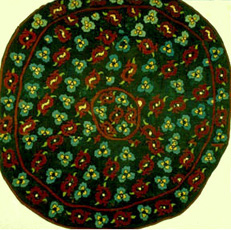
|
Floor Spread - Turkey, Late 17th
or 18th Century
acquired by George Hewitt Myers
Courtesy of The Textile Museum
|
Company was always welcome in the Ottoman
home as it was thought that each guest was a "guest from
God," and was treated accordingly. Visitors also provided
the women with a festive respite from their seclusion and daily
chores. The guest was shown into the best room of the haremlik.
A round cover was spread on the floor which sometimes functioned
as a table. At other times a cylindrical stand was placed on
top of the spread which was then covered with a matching cloth
and a lavish food tray placed on top. The coffee service is a
custom which originated during the Ottoman Empire and persists
in Turkey to this day. The prevailing belief was that if a guest
was served a cup of coffee, he would pray for his host for 40
years. The coffee ceremony was highly ritualized and was conducted
by at least 2 or 3 young girls or boys. Guests were presented
with embroidered yagliks (napkins) or towels for wiping their
hands while partaking of the refreshments.
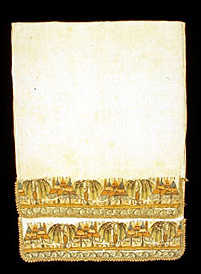
|
Yaglik (Napkin), Turkey,
19th Century
Courtesy of The Textile Museum
Gift of Leila F. Wilson
|
The bohca, a square cloth made in different
sizes, was used to wrap things to be either carried or stored.
As embroidered textiles were symbols of status and bohcas were
often used in public, great care was taken to make them beautiful.
Women employed them to carry towels to the hamam (bathhouse)
or to protect the bride's trousseau in transferring it to her
new home. Going to the hamam was a favorite pastime for the otherwise
secluded Ottoman women and constituted a festive and ceremonial
outing. It offered a place where women and girls could show off
their embroideries, their bath nalins (raised wooden clogs) and
jewelry. It also provided the opportunity for mothers to select
future brides for their sons. The quality of a prospective bride's
needlework, which reflected both her family's wealth and her
own skill, would certainly be factored in by a matchmaker.
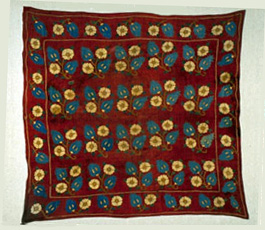
|
Bohca (Wrapping Cloth) Turkey,
18th Century
Courtesy of The Textile Museum
acquired by George Hewitt Myers, 1922
|
The most important occasion in an Ottoman
woman's life was her wedding, and preparations were begun early
in a girl's life. From the time of a girl's birth, the older
women would begin working on her ceyiz (trousseau) and the child
would join in as soon as she was old enough to hold a needle.
Her ceyiz was made up of yagliks, bath towels, covers, bohcas,
apparel, accessories and all sorts of other items for her future
home. For days before her marriage, relatives and friends would
decorate her new home with these articles. Brought wrapped in
elaborate bohcas, they would be spread out in order to view their
overall artistic impact. Yagliks, towels, dresses, scarves and
sashes would be hung on the walls. After the wedding ceremony
the bride would go to her new home dressed a magnificent bindalli
(dress), veil and slippers. Surrounded by her ceyiz, she was
presented to her guests who would scrutinize her handwork and
evaluate her stitching skills. Concurrently, festivities involving
the groom were taking place in the selamliks which included the
ritual of cutting the groom's hair. Seated, he would don a ceremonial
apron and towel (barber's set) used for the occasion. Under the
watchful gaze of the bridegroom's relatives and friends, the
barber would do his work while musicians played and sang. One
such set on display is exquisitely embroidered with intertwined
trees. The trees may symbolize the ritual joining of the married
pair, coupled with the tree of life representing fertility and
fruitfulness.
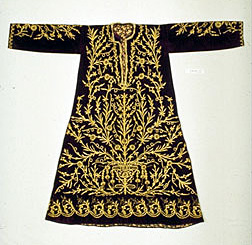
|
Bindalli (Dress) - Turkey,
Istanbul, Late 19th or Early 20th Century
Courtesy
of The Textile Museum
Gift of Mr. Yavuz Sumer
|
The basic tools used for embroidery were
the gergef, a rectangular embroidery frame standing on 4 short
legs and needles made from metal, bone or tusk. Sometimes the
gergef itself was exquisitely carved and inlaid with mother-of-pearl.
A secondary frame also used for embroidery was a round hoop called
a kasnak. Most embroidered textiles were executed on a very loosely
woven plain weave ground fabric most often made of cotton or
flax. More elaborate work was done on silk satin weaves or cotton
velvets. The stitches employed were of two types - reversible
and non-reversible. As the name implies, reversible stitches
appeared almost identical on both sides of the fabric. Ottoman
embroidery techniques were such that they prevented irregularities
and resulted in very uniform stitching. The royal embroiderers
were exceptional in their ability to create extremely diverse
effects by manipulating stitches for effect, as well as being
masters at incorporating metallic threads for further enhancement.
Throughout the late 18th and early 19th century, the use of metallic
threads was so prevalent that certain textiles were embellished
almost exclusively with them. Metal wire spirals (tirtil), sequins
and pearls were often added to highlight the designs. Prior to
embroidering, the artist would transfer the design by drawing
it directly on the fabric with a brush or inking pen, tracing
it with charcoal or by using templates or print blocks. Ottoman
embroidery from the 17th to 18th century is characterized by
compositions with very precisely detailed motifs in clear forms.
These had a defined orientation and were executed in a small
number of bold colors (red, blue, green, yellow, white and black).
Designs made up one or two motifs were placed on a diagonal or
straight alignment and were sometimes combined with a lattice
pattern to form large, free-flowing patterns. During the 19th
century designs began to lean toward more intricate and realistic
floral motifs. Ottoman decorative arts became even more lavish
and detailed with the increased influx of European influences
brought about by trade with the West.
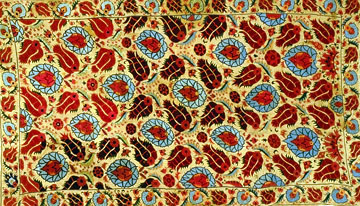
|
Cover, Turkey - 18th Century
Courtesy of The Textile Museum
Gift
of Mrs. Charles Putnam
|
Modern Turkey was preceded by seven centuries
of rule by a succession of Ottoman Sultans. At the height of
its power this dynasty ruled over an Empire that spanned the
Balkans from Greece to the Austrian frontier, most of the Middle
East, parts of North Africa, much of the Caucasus and the Crimea
and at times parts of Italy, Poland and the Ukraine. The cities
of Athens, Budapest, Belgrade, Sarajevo, Bucharest, Sofia, Beirut,
Damascus, Baghdad, Jerusalem, Mecca, Cairo, Alexandria and Tunis
were all, at some point, part of its territories. In focusing
on the 17th to early 20th centuries, Flowers of Silk and Gold
reveals the rich history and evolution of Ottoman embroidery
traditions and examines how they reflect the history, geography
and daily life of the Ottoman Sultans and their subjects. In
conjunction with this exhibition, The Textile Museum is offering
programs highlighting other aspects of Ottoman culture including
Origins and Development of Traditional Ottoman Designs (May 4),
The Spirit of Ottoman Architecture (May 11) and a Classical Turkish
Music Concert (May 14). For more information and a virtual gallery
of other items from this show, see Flowers of Silk and Gold Online
at http://www.textilemuseum.org/fsg/
The Textile Museum was founded in 1925
by George Hewitt Myers with a collection of 275 rugs and 60 related
textiles. Myers first became fascinated with textiles in college
when he purchased an Oriental rug for his dormitory room. Over
the years, his collecting tastes broadened and he continued to
collect avidly until his death in 1957. By then his collection
had expanded to encompass the textile arts of Africa, Asia and
Latin America. George Hewitt Myers' discriminating eye and cosmopolitan
tastes laid the foundation of The Textile Museum's unparalleled
collection, which consists of over 16,000 objects spanning 5000
years. The Museum is committed to exploring the extraordinary
role which textiles have played in the history and cultures of
the world in order to further the understanding of mankind's
creative achievements in this field. It functions as a center
of excellence for the research, conservation, interpretation
and exhibition of textiles, with an emphasis on the artistic,
technical and cultural significance of its collections.
The Textile Museum
2320 S Street, NW
Washington,
DC 20008-4088
phone: (202) 667- 0441
fax:
(202) 483- 0994
website: http://www.textilemuseum.org
e mail: info@textilemuseum.org
Museum hours: Mon.- Sat. 10 am to 5 pm,
Sun. 1 pm to 5 pm
Flowers of Silk and Gold - Four Centuries
of Ottoman Embroidery was curated
by Sumru Belger Krody, Associate Curator, Eastern Hemisphere
Collections, The Textile Museum. All images and textual information
for this feature story have very generously been provided by
The Textile Museum. Special thanks are extended to all personnel
at The Textile Museum who made this presentation possible.
COPYRIGHT NOTICE: No part of this feature story nor
the included designs can be reproduced or distributed in any
form (including electronic) or used as a teaching tool without
the prior written permission of the CARON Collection Ltd. or
the featured designers or contributors.
|