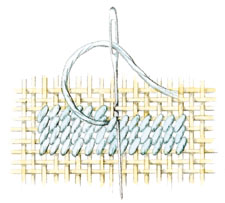
 Encroaching
or interlocking Gobelin.
Encroaching
or interlocking Gobelin.
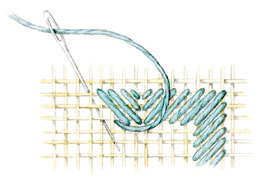 Slanted
or sloping Gobelin.
Slanted
or sloping Gobelin.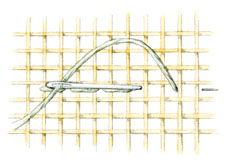 Back
stitch.
Back
stitch.
Materials
The Caron Collection Impressions 50% silk/ 50% wool thread:
1 skein each of 3056 light peach, 3064 medium rust, 5004 green,
7022 medium teal; 2 skeins each of 1144 gold, 7020 dark teal,
7024 light teal
Zweigart Lugana® 20-count 52% cotton/
48% rayon fabric, 264 ivory, 1 piece 11 ¥ 14 inches (27.9
¥ 35.6 cm)
Tapestry needle, size 24
Fabric of your choice for the back of the pillow, 1 piece
9 ¥ 12 inches (22.9 ¥ 30.5 cm)
Sewing thread to match fabric
Hand sewing needle, crewel or sharps, size 10
Frame made from 4 artist's canvas stretcher bars: 2 pieces
11 inches (27.9 cm) long, 2 pieces 14 inches (35.6 cm) long;
or needlework stretcher bars
Polyfil stuffing, 12 ounces (340.5 g)
About the Design
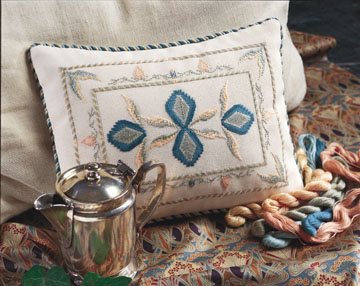
A William Morris's Artichoke panel inspired this counted-thread
embroidery pillow. The silk and wool threads add a luxurious
element to a sweet decorative accent for home or office. The
pillow is stitched on evenweave fabric and measures 812 ¥
1112 inches (21.6 ¥ 29.2 cm).
Instructions
Fold the Lugana fabric in quarters and mark the center. Mount
the fabric on the frame. Begin stitching from the center of the
design, using one strand of Impressions throughout. Work the
embroidery according to the chart and the stitch guide.
Click here for the Pillow
Chart
When the embroidery is complete, remove it from the frame,
place it face down between two layers of muslin, and press it
lightly with an iron set on "warm." Trim the embroidered
fabric to 9 ¥ 12 inches (22.9 ¥ 30.5 cm), centering the
design. Right sides together, pin the pillow top to the backing
fabric and stitch a 12-inch (1.3-cm) seam, leaving a 4-inch (10.2-cm)
opening. Turn the pillow right side out and stuff it evenly with
Polyfil. Make a twisted cord (see the sidebar below), using one
skein each of the light teal, dark teal, and gold thread. Stitch
it to the outer edge of the pillow, with a small overcast stitch,
hiding the ends of the cord in the opening. Sew the opening shut
with an invisible stitch.
 |
light peach 3056
gold 1144
medium rust 3064
light teal 7024
green 5004
medium teal 7022
dark teal 7020 |
Stitch Guide
Outer narrow border
Slanted Gobelin (green, light peach)
Large border
Large buds: Encroaching Gobelin (light peach, medium rust)
Small buds: Encroaching Gobelin (medium rust, medium teal,
green)
Vine: Back stitch (green)
Corner motif: Slanted Gobelin(green, light teal, gold)
Inner narrow border
Slanted Gobelin (green, gold)
Center
Large buds: Encroaching Gobelin (dark teal, medium teal, gold,
light teal, green)
Leaves: Slanted Gobelin (green, gold, light peach)
Making the Twisted Cord (By
Nancy Welch)
1. Without cutting the skeins, unwind one skein each of light
teal,
dark teal, and gold, and rewind it into a 120-inch (304.8-cm)
loop.
Each loop will make one strand of the cord.
2. Tie a knot in one end of one skein and slip it over a hook.
3. With your fingers, a pencil, a drill, or an eggbeater,
twist the loop clockwise until it kinks back on itself. Clamp
this end to anchor it while you twist the next loop. Repeat until
all loops are twisted.
4. Carefully release one end of each loop from its anchor.
Twist all the loops together in the opposite direction from the
original twist. Knot the free ends together, release the other
end from the anchor and knot that end as well.
Nancy Welch is the author of "Tassels: Universal Decoration".
About the Designer
Ann Caswell of Reston, Virginia, has been teaching needlework
for companies, shops, and guilds since 1979 and is a past president
of the American Needlepoint Guild. She is the design coordinator
of Jacqueline Kreinik's upcoming book about metallic threads.
Suppliers
Impressions 50% silk/50% wool thread. The Caron Collection,
55 Old South Ave., Stratford, CT 06615. (203) 381-9999. Call
or write for the name of your nearest retailer.
Lugana 20-count fabric. Zweigart Fabrics, 2 Riverview Dr.,
Somerset, NJ 08873-1139. (732) 271-1949. Call or write for the
name of your nearest retailer.
Polyfil stuffing. Fairfield Processing, PO Box 1157, Danbury,
CT 06813-1157. (800) 980-8000. Call or write for the name of
your nearest retailer.






















 From
early Colonial samplers to Japanese sashiko quilts to beaded Athapaskan
dancing boots, handwork's history is human history. The clothes
that warm us, the linens that adorn our homes, the finery that
lifts our spirits- these works have come from hands that tell
us who we have been and who we are. And using our hands to carry
on handwork that reflects our history and culture is rhythmic
and sustaining.
From
early Colonial samplers to Japanese sashiko quilts to beaded Athapaskan
dancing boots, handwork's history is human history. The clothes
that warm us, the linens that adorn our homes, the finery that
lifts our spirits- these works have come from hands that tell
us who we have been and who we are. And using our hands to carry
on handwork that reflects our history and culture is rhythmic
and sustaining.